Menu
Download our Petland App today for information on your local Petland's Available Pets and Pet Supplies. All at the tips of your fingers!


Download our Petland App today for information on your local Petland's Available Pets and Pet Supplies. All at the tips of your fingers!
Please create a free account below, or login by clicking here.
Petland Overland Park, Kansas
November 17, 2026
Ask a new puppy owner what they plan to train and you will hear a long list in one breath: sit, stay, come, heel, leave it, drop it, stop jumping, stop barking, walk nicely, behave at the vet. It sounds like a single project, and that is exactly why so many puppies learn almost none of it. Training is not one big job. It is a dozen small ones, and the order matters more than the hours you put in.
These puppy training goals spread the long list across the first year: one focus a month, from name response in month one to public manners in month twelve, with a simple test that proves each skill before you move on. A puppy that starts in January, with one goal a month, finishes the year as a dog that can walk a Kansas City sidewalk, greet a visitor, and settle in the car without drama.
Each month has one new skill and one rule: keep the old skills warm. Spend 4 minutes on the new goal and 1 minute on a skill from an earlier month, and nothing fades. The month boundaries are a guide, not a deadline. If month three’s recall is not solid by month’s end, stay on it for another week. A plan that bends is a plan a family actually finishes. A trained behavior works on the first ask, in more than one room, with a mild distraction nearby.
The first three months are about attention and trust. A puppy that looks at you when called, sits on the first ask, and comes to you in the hallway has the raw material for everything that follows. These months also hold the socialization window, which starts closing around 14 to 16 weeks, so new people, sounds, and surfaces belong in the same weeks. Our guide to the best ways to socialize your new puppy covers how to do that safely.
Say the puppy’s name once. When the puppy looks at you, mark it with a ‘yes’ and a treat. That is the whole lesson, repeated 5 to 10 times a day at meal times and potty breaks. Do not repeat the name five times to get one look; that teaches the puppy the first four calls are free. The test: your puppy turns to its name 8 of 10 times, indoors, with a toy nearby.
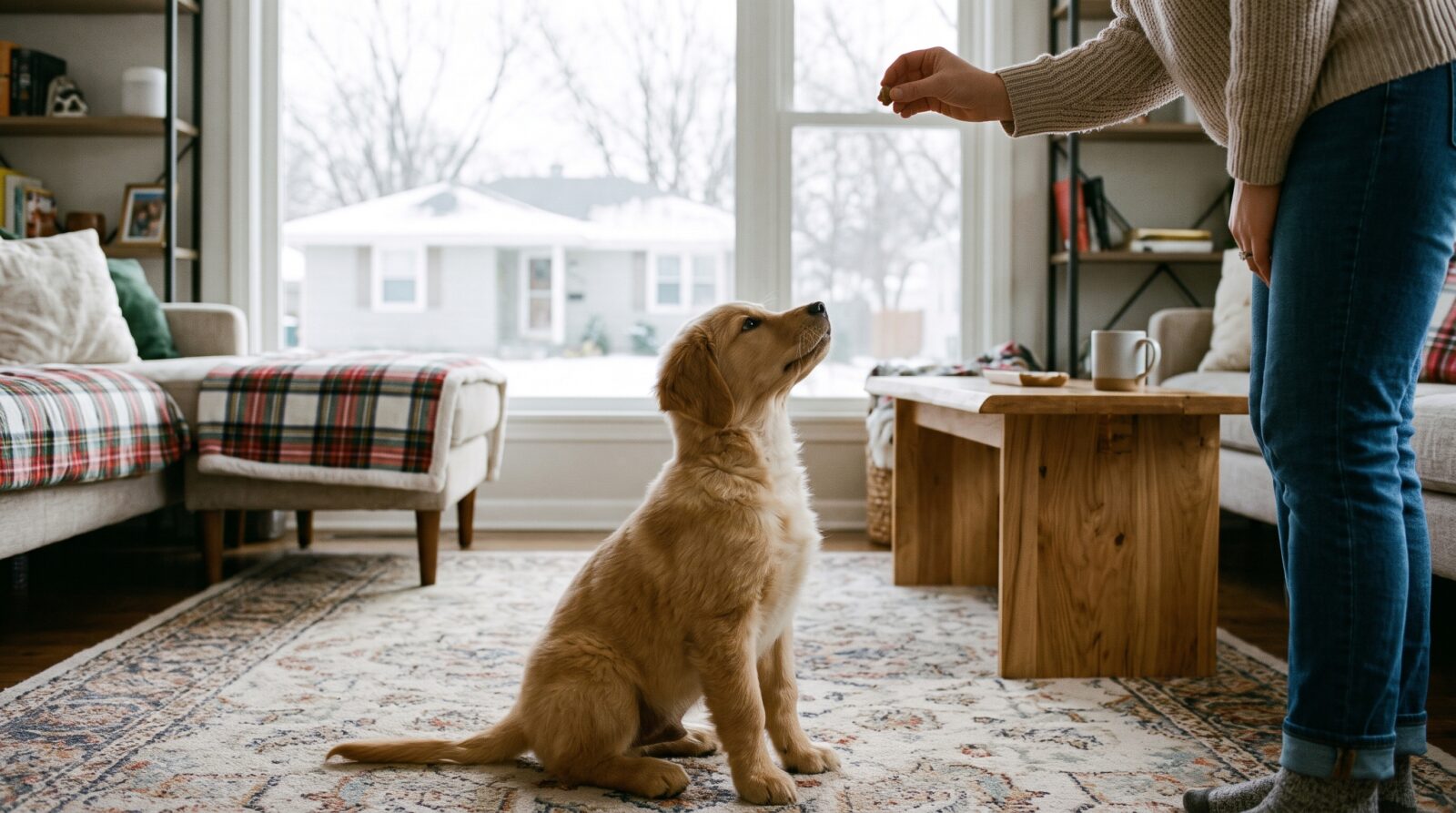
Hold a treat over the puppy’s head and move it slowly back. The head follows, the rear drops, and you mark the moment it touches the floor. Add the word ‘sit’ only once the motion is reliable, around day 4 or 5, so the word attaches to a behavior the puppy already understands. The test: your puppy sits on the first ask, in two rooms, without a treat visible in your hand.
Recall starts in a hallway, not a park. Stand 6 feet from your puppy, crouch down, say the puppy’s name and ‘come’ once, and pay with the best treat you own. Never call a puppy for something unpleasant, like a bath or the end of play, or the word starts to mean ‘the fun stops.’ The test: your puppy comes from 6 feet away, indoors, 4 of 5 times.
Months 4 to 6 are about living together without chaos: a puppy that walks without dragging you, settles while you eat, and handles short stretches alone.
Forget the neighborhood for now. Walk 10 steps up and down your hallway, treating every 2 or 3 steps your puppy stays beside you. If the leash goes tight, stop and wait for slack. The test: 10 steps indoors without pulling, twice in a row.
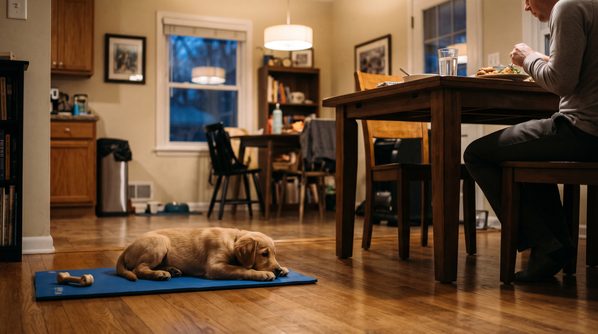
Put a mat on the floor and reward any interest in it: a look, a step, a sit. Shape it into a down-stay over a week, then add duration in 30-second jumps while you eat dinner. The test: your puppy lies on the mat for 2 minutes while you eat, getting up only when released.
Build alone time in 5-minute steps, starting with you in the next room. Leave a stuffed chew toy, go out, come back before the puppy fusses, and keep returns boring: no big greeting, no apology. The test: 30 minutes alone, calm, with nothing destroyed. If your puppy panics, drop back to the last calm length for a few days.
By month 7 your puppy has the basics, so the focus shifts to the outside world: being handled without a fuss, greeting people politely, and ignoring things on the ground. These puppy training goals are where the early work pays off, because a puppy that trusts you can learn each of them in days.
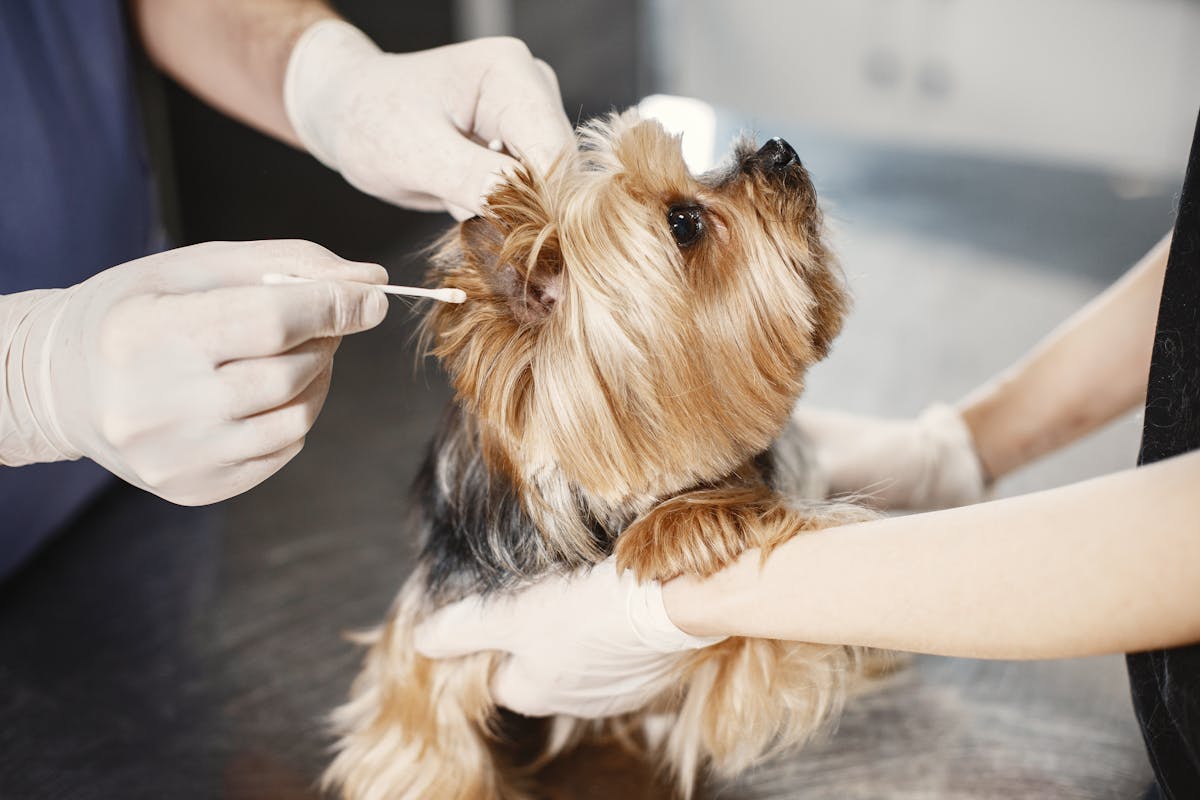
Touch one ear, treat. Lift one lip, treat. Hold one paw for 2 seconds, treat. Work through ears, mouth, paws, and tail in 2-minute sessions, and never rush the step your puppy dislikes most. The test: your puppy stands calmly while you check all four paws and both ears.
Teach your puppy that four paws on the floor is the only way greetings happen. When a visitor arrives, ask for a sit and reward the puppy for staying down. If the puppy jumps, the visitor turns away and the greeting restarts. The test: four paws on the floor for a full 10-second greeting with a new person.
Hold a treat in a closed fist. The puppy sniffs, paws, and eventually pulls back, and that pull-back earns a different treat from your other hand. Build to a treat on the floor, then one dropped on a walk. The test: your puppy ignores a treat on the floor 2 feet away on the word ‘leave it.’
Trade, don’t pry. Offer a treat or a second toy the moment your puppy holds something, and say ‘drop it’ as the item leaves the mouth. The test: your puppy drops a toy on the first ask, indoors and outdoors. A reliable drop it turns a swallowed sock into a story instead of a vet visit.
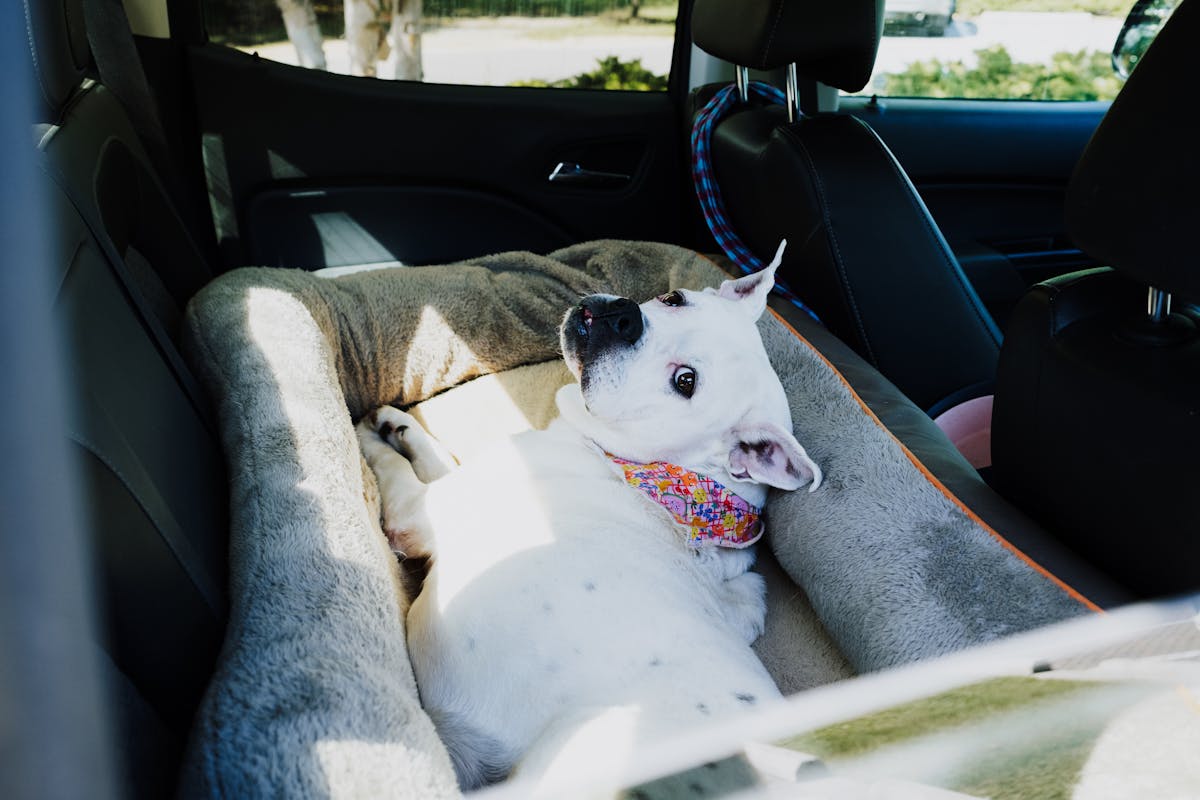
Start with the car parked: sit inside with your puppy for 2 minutes, treat, get out. Add a 5-minute drive around the block, then a 20-minute drive to a park. The test: your puppy settles for a 20-minute drive without whining or pacing. Short, boring trips first; exciting destinations come later.
Walk a busy sidewalk and practice everything at once: loose leash, a sit at every curb, a calm pass by another dog. Keep the first outings to 10 minutes and end on a win. The test: your puppy passes another dog without pulling toward it, and sits at two curbs in a row.
| Months | Focus | The Test That Proves It |
|---|---|---|
| Months 1-2 | Name response and sit | Turns to its name 8 of 10 times; sits on the first ask |
| Months 3-4 | Recall foundations and loose-leash beginnings | Comes from 6 feet indoors; walks 10 steps without pulling |
| Months 5-6 | Settle and alone time | Lies on a mat for 2 minutes; calm alone for 30 minutes |
| Months 7-8 | Handling and polite greetings | Lets you check ears and nails; greets visitors with four paws down |
| Months 9-10 | Leave it and drop it | Ignores a treat on the floor; drops a toy on the first ask |
| Months 11-12 | Car calm and public manners | Settles for a 20-minute car ride; passes another dog calmly |
The test matters more than the calendar. Move on when your puppy passes 4 days out of 5, not when the month ends.
Every puppy hits a wall somewhere, usually around month 5 or 6, when adolescence arrives and a solid skill falls apart. That is normal, not failure. Drop back to the last step your puppy could do, rebuild it for 3 or 4 days, and the skill usually comes back stronger. The year plan survives because it is a plan, not a race: our Ultimate Puppy Playbook covers the full first year in more detail, including the tricky months.
Starting in January in Overland Park means the first three months happen indoors, and that is an advantage. Name response, sit, and recall are hallway skills, and a puppy that masters them in winter is ready for the yard in spring.
Twelve months, twelve skills, one focus at a time. That is all these puppy training goals ask of you: 5 minutes, two or three times a day, with a test that tells you when to move on. Start in January with name response, trust the order, and let the plan do the heavy lifting. By next December, the puppy that could not sit still will be the dog walking calmly past another dog on a Kansas City sidewalk.
Ready to start the year with a new puppy? Visit Petland Kansas City to meet the puppies waiting for homes, and ask our team which breeds are quickest to learn: Petland Kansas City available pets.
The day the puppy comes home, with name response and house rules. Puppies learn from every interaction from 8 weeks old, so the lessons you choose are the ones the puppy learns. Short sessions of 5 minutes, two or three times a day, are enough.
Five minutes for a puppy under 4 months, and 5 to 10 minutes up to a year old. End while your puppy is still engaged, not after it has checked out. Three short sessions a day teach more than one long session, because a tired puppy stops learning.
Start at month 1 anyway. Name response, sit, and recall foundations take an older puppy about half the time, because the puppy can focus longer. Run the first three goals in 2 to 3 weeks each, then join the plan at the month that matches your puppy’s skills.
No. Treats pay for new skills, then fade. Once a behavior passes its test, reward every second or third success, then switch to praise, play, and real-life rewards like going outside. A sit that only works with a treat in hand is not finished yet.
Months 5 and 6, when adolescence hits. Skills that were solid can wobble, and a puppy that recalled perfectly may suddenly ignore you. Drop back to the last step that worked and rebuild for a few days. It passes, and the skills come back stronger.
Yes, and winter is a good time to start. Name response, sit, recall, settle, and handling are all indoor skills, and a Kansas City winter gives you months of quiet hallway practice. Keep outdoor sessions to 10 to 15 minutes on freezing days and train indoors the rest of the time.
"*" indicates required fields